Tuesday, March 28, 2017

More 2017 free fishing day announced for New York State

Based on Governor Andrew M. Cuomo's signed legislation in 2014 authorizing additional statewide free fishing days, the New York State Department of Environmental Conservation (DEC) is proposing four free sport fishing days be added to complement the state's existing free sport fishing days. DEC is seeking public comments on the proposed changes.

First established in 1991, free sport fishing days allow New York residents and non-residents to fish for free without a fishing license at any of the state's 7,500 lakes and ponds or 70,000 miles of rivers and streams.


The free events give people who might not fish a chance to try the rewarding sport at no cost, introduce people to a new hobby, and encourage people to support the sport by purchasing a New York State fishing license.

The proposed additions are:
  • Presidents Day Weekend (February 18,19 - the weekend immediately preceding Presidents Day in the month of February) - These two days generally coincide with winter recess for schools, making it ideal for families to try ice fishing.

  • National Hunting and Fishing Day (September 23, one day) - Takes place annually on the 4th Saturday in September and links to events taking place nationwide. Fishing at this time of year is generally good for many species, including fall salmon fishing in the Great Lakes tributaries.

  • Veteran's Day (November 11, one day) - Fishing is considered one of the most therapeutic outdoor activities, making it an excellent tribute to veterans and those currently serving. Governor Cuomo specified Veteran's Day as a free fishing day in 2015, and this proposal would make it a permanent free fishing day.
In addition, the last full weekend in June, (23, 24) are designated free fishing days as well.

Niagara River fishing trip

I have always wanted to drift fish the Niagara River since I first talk with one of my clients, John Field, about 20 years ago.  He introduced me to Captain John Oravec who has been guiding on Lake Ontario now for 40 some years now, and his tales of the Niagara River fishery got me interested in floating it with him.

First fish of the day, spawned out female.
Well, after years of thinking about this trip but never being able to find the time to do it, I finally set the date, dropped the deposit on it and told my son-in-laws that we were going fishing.  Weather, that is a factor related to any fishing trip here in the Great Lakes, and weather in March is as unpredictable as it gets.  We all kept an eye on the forecast in the week leading up to the trip and it seemed as though we'd have temps in the 40's and rain.  We planned for rain and cool temps.  Turned out to be dry and some sun in the afternoon moved temps into the low 50's, couldn't have been a better day weather wise.

Bonding with my son-in-laws, James(l) and Adam(r)
Adam with his first ever steelhead.
We met John at the lower ramp in Lewiston, NY and were underway by 7:45.  We headed towards the mouth of the river, our first drifts being off the high banks and further down towards the convent.  The fishing was slow but it was good to finally be fishing the Niagara River.  We picked up two steelhead in these drifts and later move to the mouth of the river and spent about 2 hours making drifts past the Coast Guard station to the end of the break wall.  With a strong east-southeast wind getting out onto the Niagara Bar was out of the question.  These drifts produced 1 fish on for one of my son-in-laws but it wrapped some bottom structure and broke him off. 

We drifted the bottom using Emerald Shiners and skein, picking up all fish on the shiners.  As the day progressed and water clarity  clouded up and we added a chartreuse trout bead in front of the shiner but had no further action.  All-in-all it was a great day fishing and spending time with Capt. John and my son-in-laws.  We are planning a fall trip on the St. Lawrence River with Capt. John for Muskies, can't wait.

Tight lines

Monday, March 20, 2017

Salmon River fishing report - first day of spring 2017

A few weeks ago it seemed as though winter had retreated until the end of next November but last week it came back with a reminder of what awaits in a few months.  The Salmon River area went from bare ground to about 2 feet of fresh snow in a day.  It could have been worse had it come from the west but being a nor'easter the south and eastern parts of the state got it hardest, 3-4 feet in some areas that normally see no more that than all winter.  But the river and roads leading to the river are open and the fishing is good.

For the last month we have been fishing around 2100 cfs. with a steady release between 1600-1700 cfs.  As I write this report the release is 750 cfs. and the gauge at Pineville is reading a comfortable 1040 cfs., expect it to hang around this number for a while.  Temperatures are still in the teens and low twenties at night so thing are melting slowly, for now.  If the melt down and spring run-off go as normal we should hit our highest flows about the 2-3rd week of April.

Steelhead have been spawning in good numbers for about 3 weeks now and we should see thing continue to heat up in the next few weeks.

Tight lines


Sunday, March 19, 2017

State of Lake Ontario meeting highlights

This past Monday, March 13, I attended the Lake Ontario Update (LOU) meeting at the Pulaski High School.  This meeting was presented by NY State DEC and the Ontario Providence equivalent.  After a lot of charts, graphs, pictures, power-points and reports on various aspects of the Lake Ontario eco-system, the highlights directly related to the Salmon River fishery is as follows.


Fish stocking in the New York waters of Lake Ontario in 2016 included approximately 1.88 million Chinook salmon, 316,000 coho salmon, 662,170 rainbow trout, 495,620 brown trout, 156,270 Atlantic salmon, 384,250 lake trout, and 68,250 walleye.  Fall 2016 Chinook and coho salmon egg collections exceeded targets, and fish survival has been good to date.


Total estimated angler effort for all tributaries in 2015-2016 was 989,437 angler hours, down considerably from the 1,582,428 hours in 2011-2012, but similar to other surveys (999,182 hours in 2005/06 and 910,413 hours for 2006/07). The Salmon River accounted for 74 % of all angler effort.


Eighteen of 21 tributaries surveyed had reported catches of Chinook salmon. The estimated catch and harvest of Chinook salmon on all tributaries surveyed in fall 2015 was 43,589 and 13,740, respectively; markedly lower than previous surveys.


Coho salmon were caught in eight of the 21 tributaries surveyed, with a total of 6,061 fish caught. The Salmon River accounted for 95% of the catch (5,738) and 89% of the harvest (2,307).

The estimated steelhead catch from all tributaries combined totaled 48,893 in 2015-2016 (from 11 of 21 tributaries), the lowest catch to date. The Salmon River again produced the highest estimated number of steelhead caught with 25,170 fish. The release rate for steelhead was 88% on the Salmon River and 85% for all tributaries combined.


Brown trout on the Salmon River were fairly scarce in 2015/16, with an estimated 372 caught.


 The percentages of wild Chinook salmon returning to NY tributaries (for the 4 years classes studied; 2008-2011) to spawn at ages 2 and 3, varied among regions, averaging 7.5% wild Chinook salmon in western region tributaries,  18% in eastern region tributaries and  58% in the Salmon River

Two points that stand out to me as good news are 1.) the numbers of steelhead being released back into the Salmon River, 88%, that is outstanding.  It shows that this resource is valued by most anglers who utilize it.
2.) The number of wild Chinook salmon returning to the Salmon River 58%, awesome, just awesome. 

We have a tremendous fishery here and I am look forward to each day I have the chance to fish it.

Tight lines


Monday, February 20, 2017

Late winter Salmon River fishing report

At a 750 cfs. release the gauge at Pineville is at 936 cfs.  The river has been flowing between 900-1100 cfs for quite a while now and this has contributed to a very consistent fishery as far as finding steelhead.  Most fish can be expected to be found in the deeper pools with the Schoolhouse, Abandoned Trestle and the Sportsman holding real good numbers.  It is also time to start seeing steelhead setting up in primary spawning areas and we will see more spawning activity as we move into March and April. 


The water temps are 34-35 degrees and with the warmer weather forecast over the next couple weeks we will see these temps stay cold as the snow slowly melt into the drainage.  Speaking of which, I took a ride up through the Redfield/ Route 2 corridor this afternoon and there is a huge snow pack.  Some areas have an easy 4-5 FEET laying on the ground right now.  Unless we get no more snow and the temps stay in the 40's and 50's over the next month or so, we will see a major run-off this spring if the warm-up happens the way it usually does here. 

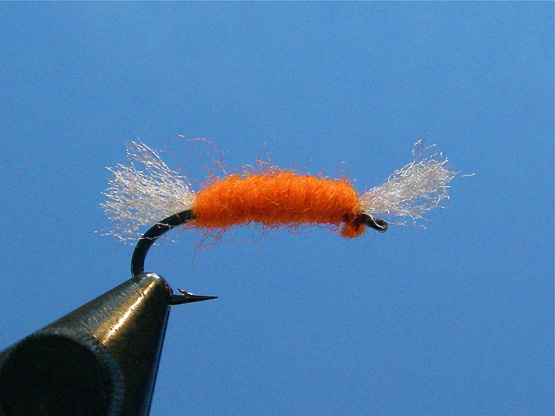
Salmon River Flea, pink, blue or orange chenille body
and a white poly wing and tail.  How simple can it get.
Right now the gear fishermen are doing good on egg sacs and smaller flies, small black stones, Salmon River Fleas and trout nymphs.  These same patterns are working with the fly rodders fished on the bottom with weight.  Normally I like to indie fish but the fish have been ignoring the indie-drifted flies for some reason.  With the water being clear with very little sediment fish are shy of line over 6-8 lb test. 

The river is very fishable and the steelhead are cooperative, for the most part.  If cabin fever is taking hold get your gear and come visit.  You wont be disappointed.

Tight lines

Friday, February 17, 2017

NYS fish for free days

February 18,19, 2017 are the first 'fish for free' days in NY State for the 2017 calendar year.  Take advantage of this opportunity to get something from NYS that is free. 

DEC Announces State of Lake Ontario Meetings

The public will have the opportunity to learn about the state of Lake Ontario fisheries at public meetings held in Niagara, Monroe, and Oswego counties in March, New York State Department of Environmental Conservation (DEC) Commissioner Basil Seggos announced today.

"Lake Ontario and its tributaries continue to provide world-class fishing opportunities for the hundreds of thousands of anglers who enjoy it every year," Commissioner Seggos said. "These fisheries provide unsurpassed recreational opportunity and generate substantial economic benefits to the surrounding communities. The state of Lake Ontario meetings provide an excellent opportunity for individuals interested in the lake and its tributaries to interact with the scientists and managers who study and manage these fisheries."

Lake Ontario and its embayments and tributaries support thriving populations of fish, including a variety of trout and salmon, bass, walleye, yellow perch, and panfish. New York's Lake Ontario waters comprise more than 2.7 million acres. A recent statewide angler survey estimated that more than 2.6 million angler days were spent on Lake Ontario and its major tributaries. The estimated value of these fisheries exceeded $112 million annually for local economies.The meeting dates and locations are as follows:

Tuesday, March 7: 6:30 - 9 pm at the Cornell Cooperative Extension Building, 4487 Lake Ave., Lockport, Niagara County. The meeting is co-hosted by Niagara County Cooperative Extension and the Niagara County Sportfishery Development Board.

Thursday, March 9: 6:30 - 9 pm at the Rochester Institute of Technology (RIT) campus (Chester F. Carlson Center for Imaging Science building (76-1125) - Carlson Auditorium), Rochester, Monroe County. The meeting is co-hosted by RIT and the Monroe County Fishery Advisory Board.

Monday, March 13: 6:30 - 9 pm at the Pulaski High School auditorium, 4624 Salina St., Pulaski, Oswego County. The meeting is co-hosted by the Eastern Lake Ontario Salmon and Trout Association. In the event of heavy lake-effect snow, the meeting will be held at the same time and location on March 14.

Staff from DEC, the United States Geological Survey, and the U.S. Fish and Wildlife Service will share presentations, including updates on the status of trout and salmon fisheries in the lake and its tributaries, forage fish, and stocking programs. The meetings will provide ample time at the end of the scheduled program for the audience to interact with the presenters.

Information about DEC's Lake Ontario fisheries assessment programs can be found on DEC's website. For additional information contact Steven LaPan, New York Great Lakes Fisheries Section Head at the Cape Vincent Fisheries Research Station, (315) 654-2147.